
Civil Rights & §1983
When the government oversteps, the Constitution still matters.
Few attorneys do this work. Fewer will tell you the truth about it.
Constitutional violations by police and government actors. False arrest. Excessive force. Unlawful searches. Retaliation for protected speech. 42 U.S.C. §1983 provides the remedy when state and local government actors deprive you of constitutional rights. We take this work because few attorneys do it competently — and the people who need it most are often the people least able to navigate the system alone.
Why this practice matters
Constitutional rights are not abstract.
Section 1983 is not a general-purpose complaint statute. It is a specific cause of action against a person acting under color of state law who deprives someone of a right secured by the Constitution or federal law. Which right was violated determines everything that follows — the standard, the defenses, and whether there is a case at all.
Fourth Amendment
Protection against unreasonable searches and seizures. When police search your home, vehicle, or person without proper authority — or use excessive force in seizing you — §1983 provides the remedy.
First Amendment
Protection of speech, assembly, and the right to petition. Retaliation by government actors for protected speech is actionable. Restrictions on protest, on recording police, on religious practice — all constitutional questions.
Due Process
Government cannot deprive you of life, liberty, or property without proper process. When the process fails — wrongful detention, lack of hearing, denial of representation — there are claims worth pursuing.
Equal Protection
Selective enforcement. Discriminatory treatment by government actors. When the government applies the law differently to different people based on who they are, that’s a constitutional violation.
Differentiated experience
I wrote about this convergence years before it was current.
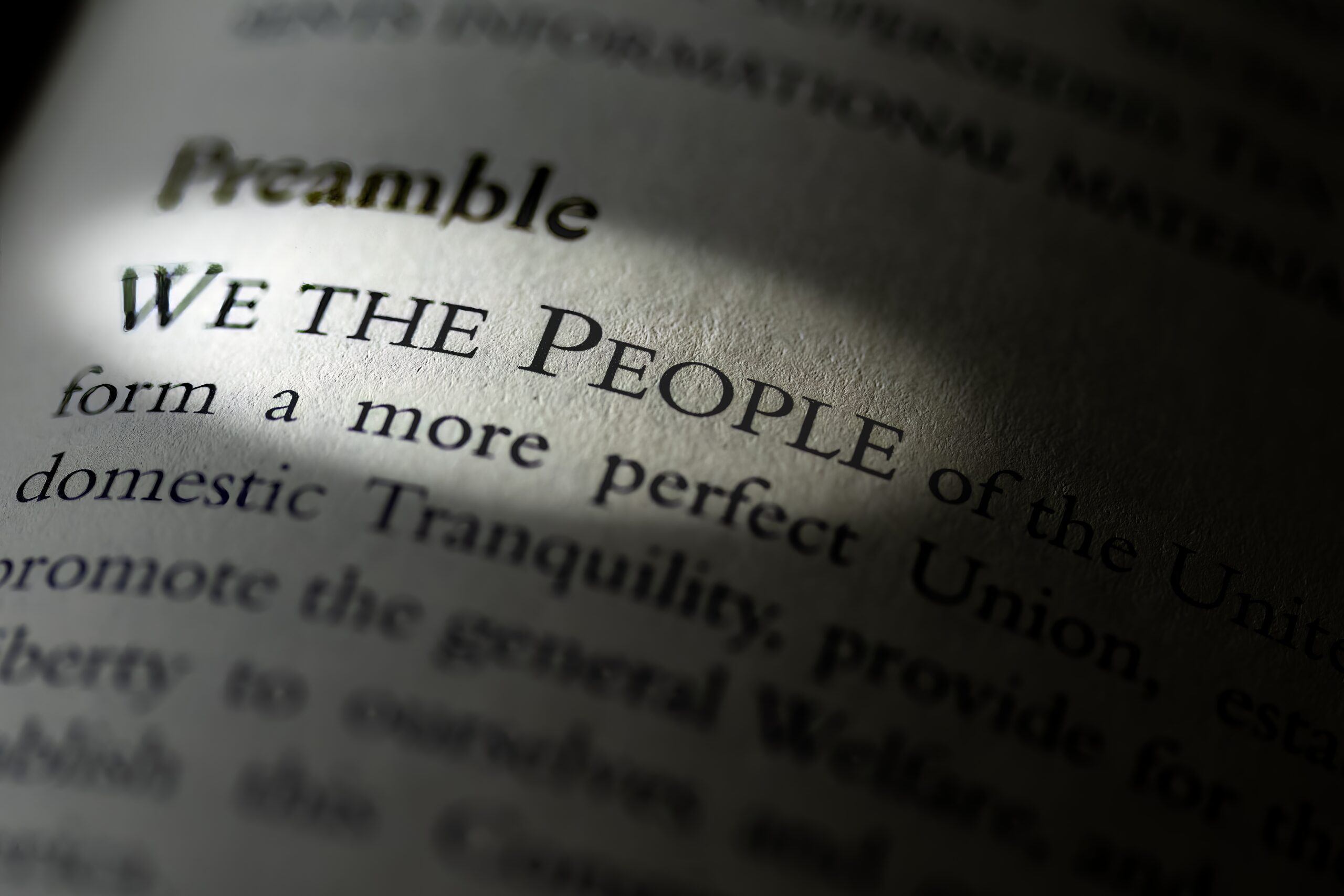
My 2010 law school thesis examined the convergence of constitutional law, data privacy, and government surveillance — analyzing how the Fourth Amendment, the Electronic Communications Privacy Act, the Stored Communications Act, and the Privacy Act interact (and fail to interact) with modern data collection.
Written in 2010, it identified issues — predictive profiling, government use of telecommunications data, ‘guilt by association’ data mining, algorithmic surveillance — that have only grown more central to constitutional law since. For matters at the intersection of constitutional rights and technology, we bring genuinely differentiated expertise.
That matters practically, not just academically. A modern §1983 case runs on body camera footage, dashcam video, automated license plate readers, cell site data, and department records systems — evidence that has to be demanded correctly, read accurately, and preserved before it cycles off a retention schedule.
What we handle
Constitutional violations by government actors.
Fourth Amendment Claims
Unlawful searches of homes, vehicles, persons, and digital devices. False arrest and false imprisonment. Excessive force. Civil asset forfeiture matters. Wrongful detention.
First Amendment Claims
Retaliation for protected speech — including by government-actor employers. Restrictions on protest. Right to record police. Religious freedom matters.
Due Process & Equal Protection
Procedural and substantive due process violations. Selective enforcement claims. Public employment matters for government employees facing constitutional issues.
Surveillance & Digital Privacy
Government surveillance challenges. National Security Letter responses. Public records and Missouri Sunshine Law matters. §1983 claims involving technology — body cameras, facial recognition, automated systems.
Police Misconduct
Excessive force claims. False arrest. Wrongful detention. Retaliation against citizens. The matters where individuals need representation against well-funded government defendants.
Section 1988 Fee Recovery
42 U.S.C. §1988 allows prevailing plaintiffs in civil rights cases to recover attorney fees from the government defendant. This affects fee structure — we discuss it at engagement.
Evidence in these cases sits on a retention schedule.
Body camera and dashcam footage is routinely overwritten, and departments are not obliged to keep it for you.
Retention varies by agency and by how an incident was classified — sometimes months, sometimes far less. A preservation request and a records request sent early cost nothing and cannot be sent retroactively. Tell us what happened and when, and we will tell you what should be requested now.
How it works
Civil rights cases are different.
They involve qualified immunity defenses, complex causation, and damages that are hard to quantify. They take time. They face well-funded government defendants. Our process reflects that reality.
Honest assessment
Not every constitutional violation produces a viable lawsuit. Qualified immunity, statutes of limitations, and procedural requirements eliminate many cases. We tell you honestly whether your matter has a realistic path.
Investigation
If we proceed, we investigate carefully — records requests, witness interviews, video footage, internal affairs files. Building the factual record is the foundation of a §1983 case.
Demand or filing
Some matters resolve through pre-litigation demands to the government entity. Most do not. We file when filing is required to get to resolution.
Litigation
Discovery, motions, summary judgment, trial. §1983 cases run longer than typical civil matters. We prepare for the long haul from engagement.
Straight about the federal courts
How a federal filing gets handled here.
Most §1983 cases belong in federal court, and we would rather you hear this from us than discover it later. Haake Law Group does not yet hold admission in the Eastern or Western Districts of Missouri or the Eighth Circuit. Those admissions are being pursued.
What that means in practice is narrower than it sounds, and it does not stop a case from moving. The work that decides a §1983 claim happens early and happens outside the courtroom: the intake assessment, the qualified-immunity analysis, the preservation and records requests, the investigation, and the pre-suit demand. All of that is handled here, directly, by the attorney you hired. Where a federal filing is the right step, we co-counsel with an admitted attorney rather than hand your case away — we stay on it, and you keep the same point of contact.
Some of this work never needs a federal filing at all. State-court claims, records and Sunshine Law matters, pre-litigation demands, and administrative proceedings are handled start to finish. And in every case, the first honest conversation about whether you have a claim worth pursuing is the same conversation regardless of which courthouse it eventually reaches.
Why Haake Law Group
Built around your situation, not our office hours.
Published scholarship
Derek’s 2010 University of Akron law school thesis examined constitutional law, data privacy, and government surveillance — issues now central to §1983 practice. Few civil rights attorneys have published academic work in this area.
Technology-fluent
Modern civil rights cases increasingly involve digital evidence, body cameras, facial recognition, and automated systems. Derek’s pre-law technology background means we read this evidence the way it actually works.
Honest qualified-immunity analysis
Qualified immunity is a significant hurdle. We assess it at intake and tell you honestly how it affects your matter — not after a year of pre-trial work.
Contingent fee arrangements available
Many civil rights matters can be handled on contingent or hybrid fee arrangements. Some — particularly injunctive relief cases — may be hourly. Structure is disclosed in writing at engagement.
Meet Derek Haake
He wrote about warrantless cell tracking in 2010.

The pairing here is not drafting and litigating — it is building and challenging. Derek wrote the data-mining software and taught the classes that let a telecommunications company retrieve anything it held on a customer. He now litigates against the government systems built on the same principles. Very few lawyers challenging surveillance have been on the inside of it.
Derek’s law school thesis — Personal data collection, data mining, privacy, fairness and national security, submitted 31 March 2010 for a Seminar in National Security Law at the University of Akron School of Law — described the NSA’s database of Americans’ phone records, the FBI’s use of National Security Letters against more than 11,500 citizens and residents in a single year, and a device called a “triggerfish” that let law enforcement pinpoint and monitor every cell phone in an area without a warrant. That was three years before Snowden, and years before most people had heard the word stingray.
Its central worry has aged well. Third parties, he wrote, “only see an audit trail of where you have been, what you have purchased. They do not understand your logic, thoughts or methodology” — opening the door to “embarrassment, wrongful convictions, improper hiring practices, credit abuse.”
He was not writing from the outside. As a data analyst at a major telecommunications carrier he wrote that data-mining software himself, and taught a three-day SQL class that let staff across the company retrieve anything held in databases containing customers’ social security numbers, credit scores, bank details, up to nine addresses, and every call they had ever made.
A §1983 case today runs on body camera footage, cell site data, automated licence plate readers and department records systems. Knowing what those systems actually hold — and what they quietly do not — is the difference between a records request that works and one that gets a polite refusal.
Common questions
What clients ask before they hire us.
What is qualified immunity?
A judge-made doctrine that protects government officials from liability unless they violated ‘clearly established’ law. It is a significant hurdle in many civil rights cases. We assess qualified immunity issues at intake and tell you honestly how it affects your matter.
The standard traces to Harlow v. Fitzgerald, 457 U.S. 800 (1982): officials are shielded unless their conduct violated clearly established statutory or constitutional rights of which a reasonable person would have known. Under Pearson v. Callahan, 555 U.S. 223 (2009), a court may decide the “clearly established” question without ever deciding whether a violation occurred — which is part of why the law develops slowly in this area.
The practical difficulty is specificity. It is rarely enough to say excessive force is unconstitutional; courts often ask whether existing precedent put the question beyond debate in circumstances close to yours. Two cases with similar facts can come out differently because one circuit had a controlling case on point and the other did not.
Two things follow. First, the analysis is done at intake, not after a year of work — qualified immunity is raised early and is immediately appealable, which is why it shapes the cost and timeline of the whole case. Second, it does not apply to everyone: municipalities themselves cannot assert qualified immunity, which is one reason claims against the entity are considered alongside claims against the individual officer.
What is the deadline to file?
Missouri’s general personal injury statute of limitations (5 years) applies to most §1983 claims. Some federal claims have their own deadlines. Some have shorter notice requirements. Contact us as soon as possible after the violation.
Section 1983 has no limitations period of its own, so federal courts borrow the forum state’s general personal injury period. The Eighth Circuit settled that Missouri’s five-year period under RSMo § 516.120 applies, in Sulik v. Taney County, 393 F.3d 765 (8th Cir. 2005).
When the clock starts is federal law and is often the harder question. Some claims accrue at the moment of the violation; a malicious prosecution claim generally does not accrue until the criminal proceeding terminates in your favor, per Thompson v. Clark, 596 U.S. 36 (2022).
Do not rely on the five years. Any state-law claims joined alongside the federal one may carry much shorter periods and municipal notice requirements, and the evidence — particularly video — is gone long before the statute runs.
What is the standard for excessive force?
Objective reasonableness under the Fourth Amendment. Graham v. Connor, 490 U.S. 386 (1989), asks whether the officer’s use of force was objectively reasonable in light of the facts confronting them, judged from the perspective of a reasonable officer on the scene rather than with hindsight. Courts weigh the severity of the crime, whether the person posed an immediate threat, and whether they were actively resisting or fleeing. For deadly force, Tennessee v. Garner, 471 U.S. 1 (1985), requires probable cause to believe the suspect poses a significant threat of death or serious physical injury.
There is an important recent development. In Barnes v. Felix, decided May 15, 2025, a unanimous Supreme Court rejected the “moment of threat” rule, under which some courts looked only at the instant force was used and ignored everything before it. Writing for the Court, Justice Kagan held that “to assess whether an officer acted reasonably in using force, a court must consider all the relevant circumstances, including facts and events leading up to the climactic moment.” See the opinion.
That matters to real cases. Whether an officer created the danger by how the encounter was approached, whether de-escalation was available, and what happened in the minutes before are now squarely part of the analysis rather than excluded from it.
Can I sue the city or the police department itself?
Sometimes, and it is worth knowing why it is hard. Under Monell v. Department of Social Services, 436 U.S. 658 (1978), a municipality is liable under §1983 only where the constitutional violation resulted from an official policy or a custom so widespread it carries the force of policy — not merely because it employed the officer. There is no respondeat superior liability under §1983.
A Monell claim is typically built one of a few ways: an official written policy that is itself unconstitutional; a pattern of similar prior incidents putting the entity on notice; a decision by an official with final policymaking authority; or failure to train amounting to deliberate indifference under City of Canton v. Harris, 489 U.S. 378 (1989).
Two structural points. Municipalities cannot claim qualified immunity, so a viable Monell claim survives a defense that would defeat the claim against the officer individually. But states and state agencies are not “persons” subject to suit under §1983 at all — Will v. Michigan Department of State Police, 491 U.S. 58 (1989) — so who the defendant is changes the analysis entirely.
Proving a pattern takes records: prior complaints, internal affairs files, training materials, and discipline history. It is the most document-intensive part of this work and a real reason these cases run long.
I was arrested but the charges were dropped. Do I have a claim?
Possibly, and the answer turns on probable cause rather than on the dismissal. A false arrest claim requires that the arrest was made without probable cause; charges being dropped does not by itself establish that, because prosecutors dismiss cases for many reasons.
For a Fourth Amendment malicious prosecution claim, Thompson v. Clark, 596 U.S. 36 (2022), holds that you need only show the prosecution ended without a conviction — you do not have to prove affirmative indications of innocence.
Chiaverini v. City of Napoleon, decided June 20, 2024, added something useful: the presence of probable cause on one charge does not categorically bar a malicious prosecution claim based on a different charge that lacked it. Courts evaluate each charge rather than treating one valid charge as a shield for the rest.
One threshold matters a great deal. Under Heck v. Humphrey, 512 U.S. 477 (1994), you cannot bring a §1983 claim that would necessarily imply the invalidity of a conviction that still stands. If you were convicted of anything arising from the incident — including a plea to a lesser charge — tell us at the first conversation, because it may control what can be brought.
I was arrested after criticizing or recording an officer.
That is a First Amendment retaliatory arrest claim, and the law here moved recently in a helpful direction. Under Nieves v. Bartlett, 587 U.S. 391 (2019), the general rule is that probable cause for the arrest defeats a retaliatory arrest claim — with a narrow exception where objective evidence shows that people not engaged in the same protected speech were not arrested in similar circumstances.
In Gonzalez v. Trevino (2024), the Supreme Court held that this exception is not limited to comparator evidence of otherwise identical individuals, and that a plaintiff may use other objective evidence — there, evidence that the statute had essentially never been used against conduct like hers. That widened a door the lower courts had been closing.
Recording police in public is separately protected. Federal courts of appeals have widely recognized a First Amendment right to record officers performing their duties in public, subject to reasonable time, place and manner restrictions.
Evidence is what makes these cases. Your own recording, bystander video, body camera footage, and the agency’s own arrest data on how that charge is ordinarily used all matter — and all of it needs to be requested early.
Will the police investigate themselves?
Internal affairs investigations are not legal proceedings and do not affect your civil rights claim. You can pursue a §1983 lawsuit regardless of the outcome of any internal investigation.
The distinction is worth understanding. An internal investigation asks whether an officer violated department policy; your claim asks whether the officer violated the Constitution. Those are different questions with different standards, and an officer can be cleared internally while the conduct is still unconstitutional.
The file itself is often valuable even so. Internal affairs records, prior complaints against the same officer, and discipline history are frequently the backbone of a Monell claim — because they show whether the entity had notice of a problem. Those records are obtained in discovery or through a records request, and they are among the first things we go after.
Filing a complaint with the department is your decision. It creates a contemporaneous record, which is useful. But it does not pause any deadline, and anything you say in it can be used later — so it is worth a conversation first.
Will I have to face the officer in court?
Possibly — in deposition and at trial. We prepare clients carefully for both. Many cases resolve before trial.
Most of the process is not a confrontation. Written discovery, records, and video do the majority of the work, and the officer’s own deposition usually happens before yours in any event. When your deposition comes, you will have prepared for it thoroughly, and your attorney is in the room throughout.
It is fair to say plainly that this part is hard for people who were genuinely frightened by the encounter. Being asked to recount it in detail, by a lawyer whose job is to make you seem unreliable, is difficult. Knowing that going in, and preparing for it properly, is most of what makes it manageable.
How long does a §1983 case take?
Civil rights cases typically run longer than ordinary civil matters — often 2 to 4 years. Government defendants are well-resourced and willing to fight. We prepare for the duration at engagement.
There is a structural reason beyond resources. A denial of qualified immunity is immediately appealable before trial, which means a case can be paused and sent to the court of appeals mid-stream and return a year or more later. Few other civil cases work this way, and it is the single largest source of delay in §1983 litigation.
Monell discovery adds time as well, because pattern evidence means years of complaints, training records, and discipline files rather than one incident report.
What we can commit to is telling you which phase you are in and what is actually causing any delay. Most of the frustration in these cases comes from silence rather than from time.
How are fees handled?
Many matters can be handled on contingent or hybrid fee arrangements. Some — particularly cases seeking injunctive relief — may require hourly billing. 42 U.S.C. §1988 allows fee recovery from government defendants when you prevail. Structure is disclosed in writing at engagement.
Section 1988(b) is the reason this work is viable at all. It permits a court to award a prevailing party in a §1983 action a reasonable attorney’s fee as part of the costs, calculated on the hours reasonably expended at a reasonable rate rather than as a share of the damages.
That has real consequences for you. It means a case seeking modest damages but vindicating an important right can still be brought, and it means a case seeking an injunction — where there may be no damages at all — is not automatically uneconomic. It also means the fee question is negotiated as part of any settlement, which is a detail worth understanding before you get there.
Whatever the structure, it is confirmed in a written engagement agreement before substantive work begins, and Missouri Rule 4-1.5 requires the fee to be reasonable and its basis communicated to you.
What should I do right now, and what should I bring?
Write down what happened while you remember it, with dates, times, locations, and the names and badge numbers of everyone involved. Contemporaneous notes are evidence; a reconstruction two years later is testimony.
Photograph any injuries immediately and again as they heal, and get medical treatment — the records are both care and proof. Preserve your own video and your phone data, and identify anyone who saw it.
Most urgently, video held by the agency needs a preservation request. Body camera and dashcam retention varies by department and by how the incident was classified, and footage that is not flagged can cycle off. A written request costs nothing and is the single most time-sensitive step.
To the consultation, bring any citation, charging document, arrest or incident report, bond paperwork, medical records, photographs, video, and the names of witnesses. Incomplete is fine — the gaps are often as informative as the documents. You will leave knowing whether the claim has a realistic path, how qualified immunity bears on it, and what to do in the next two weeks.
Ready to start?
Tell us what happened.
Initial consultations are free and confidential. We will tell you honestly whether you have a viable §1983 claim, how qualified immunity bears on it, what it would take to pursue, and what realistic outcomes look like.
Schedule a Free Consultation(314) 732-1547
Email derek@haakelawgroup.com · Offices in Wildwood, MO & St. Louis, MO (by appointment)
This page is general information, not legal advice, and does not create an attorney-client relationship. Past results do not guarantee a similar outcome, and no result is promised or implied. Constitutional litigation depends heavily on the particular facts and on controlling precedent in the relevant circuit. The scope of any engagement is set out in a written agreement. Consult a licensed attorney about your situation.